On Intellectual Activism by Patricia Hill Collins
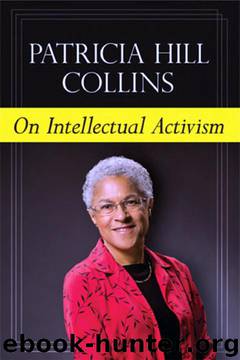
Author:Patricia Hill Collins [Collins, Patricia Hill]
Language: eng
Format: epub
Published: 2012-11-07T08:48:00+00:00
The Griot: I have one more question, which is just a way of reflecting on a lot of things that you've just covered. What is your view of the changing relationship between black feminism and other related forms of critical inquiry and mainstream sociology and similar disciplines, say between the 1980s and now?
Patricia Hill Collins: I think there's been this dual response-one good, one bad. Most things are always a both/and situation. On one hand, I see a substantial amount of co-optation of what used to be progressive scholarship. What happens when dissident scholarship or critical black theory or black feminist thought or Women's Studies or Ethnic Studies or Gender Studies or whatever gains visibility begins to influence political practice? Mainstream disciplines realize the power of these ideas and, to protect their own privilege, often appropriate ideas and recast them for their own purposes. On the other hand, if practitioners in critical areas are sufficiently strategic and do not mistake praise for acceptance, or inclusion for transformation, then progressive scholarship can become even stronger. The essence of progressive scholarship becomes tested in the crucible of academic experience. If you cannot find a way to be progressive within academia, how powerful are your ideas?
The area of race/class/gender studies illustrates both of these tendencies. Originally, race/class/gender studies came out of clearly defined social movement agendas from the 1960s and 1970s for challenging social inequities and unjust social hierarchies. Black feminism was at the forefront of birthing, in the academy, Black feminist thought, race/class/gender studies, and most recently, intersectionality. Black women argued that the solution to our problems was impossible through frameworks that focused exclusively on race, gender, class, or sexuality. Instead, Black feminist intellectuals argued that new and more empowering realities for Black women could be created only by conceptualizing how race, class, gender, sexuality, and age, for example, all worked together. Because that was an innovative and powerful statement in the context of social movement politics of the 1960s and 1970s, it traveled widely among social movements and into the academy in the 1980s and 1990s. The issue lies not with the flow of ideas but rather with how ideas travel, how some are shut down in some settings, and how they are expanded and embraced in others. This is the story that we're still monitoring.
The ways in which these ideas have traveled is simultaneously disappointing and encouraging. On the one hand, the phrase "race/class/gender" is widely used within academia. But sometimes it's just a phrase that is used to strip off or strip mine the best ideas from that body of critical thought. For example, many academics found that, if they incorporated some variation of the phrase "race/ class/gender" in the title of their paper or presentation, they became more marketable-even though they really had very little understanding of race or gender, or were not particularly interested in the field itself. This usage of the term "race/class/gender" in this fashion as a mantra impoverishes the area.
On the other hand, I
Download
This site does not store any files on its server. We only index and link to content provided by other sites. Please contact the content providers to delete copyright contents if any and email us, we'll remove relevant links or contents immediately.
| Anthropology | Archaeology |
| Philosophy | Politics & Government |
| Social Sciences | Sociology |
| Women's Studies |
Nudge - Improving Decisions about Health, Wealth, and Happiness by Thaler Sunstein(7707)
The Fire Next Time by James Baldwin(5446)
iGen by Jean M. Twenge(5416)
Adulting by Kelly Williams Brown(4574)
The Sports Rules Book by Human Kinetics(4387)
The Hacking of the American Mind by Robert H. Lustig(4383)
The Ethical Slut by Janet W. Hardy(4253)
Captivate by Vanessa Van Edwards(3839)
Mummy Knew by Lisa James(3692)
In a Sunburned Country by Bill Bryson(3542)
The Worm at the Core by Sheldon Solomon(3487)
Ants Among Elephants by Sujatha Gidla(3467)
The 48 laws of power by Robert Greene & Joost Elffers(3291)
Suicide: A Study in Sociology by Emile Durkheim(3022)
The Slow Fix: Solve Problems, Work Smarter, and Live Better In a World Addicted to Speed by Carl Honore(3009)
The Tipping Point by Malcolm Gladwell(2922)
Humans of New York by Brandon Stanton(2873)
Get What's Yours for Medicare: Maximize Your Coverage, Minimize Your Costs by Philip Moeller(2732)
Handbook of Forensic Sociology and Psychology by Stephen J. Morewitz & Mark L. Goldstein(2705)
